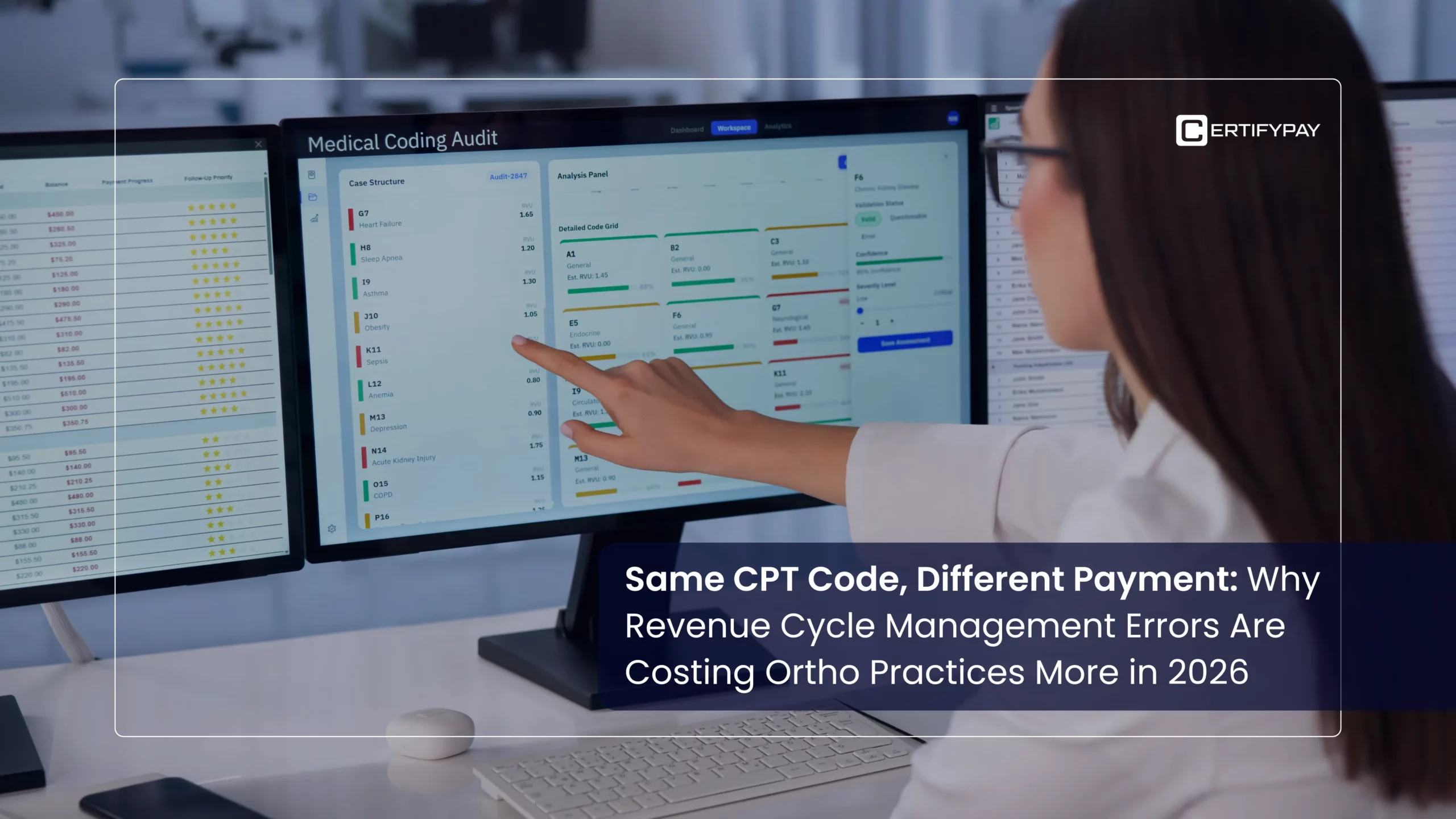
CMS continues to refine how payments differ by care setting in 2026, making site-of-service accuracy more financially impactful than before.
These changes are already hitting orthopedic claims.
If your team sends clean claims but still gets low payments, the problem may not be your coding. It may be where the procedure was done.
You sent the claim. The CPT code was right. The procedure went fine. But the payment came back low. Again.
Does that sound familiar?
If you run billing for an orthopedic practice that works across an office, an ASC, and a hospital outpatient department, this is likely happening more than you think. And in most cases, it is not a coding mistake. It is a site-of-service mismatch.
While Medicare has long adjusted payments by care setting, 2026 updates and operational complexity are making these differences harder to manage, and easier to miss.
The same CPT code can now pay different amounts based on the care setting. If your revenue cycle management process does not track that, you are losing money. Quietly. Week after week.
This article covers what changed in 2026, the three most common billing failures in ortho practices, and how to stop them before they cost you more.
What Changed in 2026
The 2026 updates are not one big rule. They are a set of changes that all make site-of-service accuracy more important.
1. Payment now depends more on care setting
Under the 2026 Physician Fee Schedule, CMS changed how practice costs are split between office and facility settings.
The idea is simple. Running a physician office costs more overhead than using a hospital facility. Payments now reflect that difference more clearly.
The result: the same CPT code can pay less in a facility setting than in a non-facility setting.
2. More ortho procedures can now be done at ASCs
The January 2026 ASC Payment update added new procedures to the ASC covered list.
This improves flexibility. But it also means more opportunities for billing data to fall out of sync with scheduling and auth data.
3. New prior auth rules underWISeR
The WISeR Model introduces pre-service and pre-payment review requirements for select procedures in certain states.
Six states: Ohio, Arizona, Oklahoma, Texas, New Jersey, and Washington.
In these states, select outpatient ortho procedures, including certain knee and spine services, now require prior auth or pre-payment review before Medicare pays.
Getting the right documentation at scheduling is now a billing requirement. Not a best practice.
All three changes are live. Together, they make site-of-service accuracy a direct driver of how much you get paid.
Problem 1: The Same Code Pays Differently — and Your System May Not Know
Your surgeon does a procedure at the ASC on Monday. A colleague performs the same procedure at the hospital outpatient department on Tuesday.
Same CPT code. Different payment.
That is expected under 2026 CMS rules. But here is the problem: many revenue cycle management software systems fail to carry the correct care setting from scheduling through to the final claim.
When that happens:
- The wrong place-of-service gets filed
- Needed modifiers are missing or wrong
- The claim gets repriced, not rejected
That last point is the real risk. The claim gets paid, just at a lower rate. Most teams do not spot it unless they actively compare paid amounts against their contract rates by care setting.
What to do:
Capture the procedure location at scheduling, not later in billing. Ensure it flows through the entire revenue cycle. If that step is manual, errors are inevitable, and revenue loss follows.
Problem 2: The Auth Covers One Setting, but the Procedure Happens in Another
This issue starts in scheduling.
A procedure is authorized for the physician office. On the day of the visit, it shifts to the ASC. No one updates the auth.
The procedure is completed. The claim reflects the ASC. The auth reflects the office. The result: denial or reduced payment.
In 2026, this matters more under WISeR. For covered services, the auth must reflect the right setting and be submitted before the procedure.
If the main service is denied, related charges — like anesthesia and facility fees — can be denied too.
What to do:
Auth workflows must flag setting changes in real time. If the procedure location changes, auth must be updated before the service happens.
Problem 3: Denials Get Worked, but the Root Cause Never Gets Fixed
Most billing teams are effective at working denials. The problem is not efforts but repetition.
The problem is that the same denials come back each week. The underlying gap is never addressed.
Setting errors tend to show up as patterns:
- Low payments tied to specific locations
- Missing or incorrect modifiers
- Claims with incomplete or inconsistent data
These are not isolated mistakes. They are systemic issues.
The best practices use denial data as a signal. They track which settings, payers, and procedures keep showing up. Then they fix the step that keeps causing the problem.
What to do:
Focus on where mismatches begin, not just where denials appear. If you cannot trace a denial back to its origin, you will keep solving the same problem repeatedly.
Why Better Patient Collections Will Not Fix This
This is worth stating clearly.
Site-of-service billing errors are not a patient payment problem. They are payer payment issues.
When a claim is underpaid due to a setting mismatch, the loss happens before the patient is billed. No payment tool or faster collections workflow will recover that revenue.
Patient collections matter. Revenue cycle management integrity matters. But they fix different problems. Solving one will not solve the other.
Three Signs You Have a Site-of-Service Problem Right Now
1.You see low payments instead of denials
Claims go through. But the amounts are below your contract rates for that setting.
2.Denials pile up around the same procedures or locations
Repeated patterns indicate a process gap, not isolated errors.
3.Your system does not track setting at scheduling
If it doesn’t, your billing team is correcting errors manually, which does not scale.
How CERTIFY Health and CERTIFYPAY Work Fix This Together
CERTIFY Health Helps You Capture the Right Data Upfront
Site-of-service errors start before billing. They happen at scheduling, intake, and authorization.
CERTIFY Health’s revenue cycle management software supports clean inputs for accurate billing outcomes:
- Captures the correct care setting at scheduling and carries it through to the claim, so payments match the right rate the first time
- Flags changes when procedures move between office, ASC, or hospital
- Ensures eligibility verification and auth match the actual setting
CERTIFYPAY: Ensure Payment Accuracy Downstream
Get paid the right amount the first time
When the correct setting flows into your revenue cycle management software, payments match expected rates. No silent underpayments.
Give patients accurate cost estimates
Costs change by setting. CERTIFYPAY calculates the right patient responsibility before the visit, ensuring smooth patient payment collection.
Avoid delays when cases move
If the setting changes, estimates and payment workflows update with it. That means fewer resubmissions.
Catch underpayments your team may miss
See when payments do not match expected rates by setting, payer, or procedure, and fix it fast.
Keep payment posting clean
Payments are auto-posted to your revenue cycle management software for real-time accuracy.
Together, they close the gap
CERTIFY Health ensures the setting is correct at the start.
CERTIFYPAY ensures you get paid correctly at the end.
The Right Move: Audit Your Site-of-Service Accuracy
Pull three months of claims from each of your settings. Compare what was paid against what should have been paid by location.
Look for:
- Low payment patterns at specific sites
- Auth data that does not match the claim setting
- Repeated denial reasons
The goal is not to fix old claims. It is to find and fix the process that keeps creating new ones.
Ready to Stop the Revenue Leak?
Site-of-service billing errors are workflow failures — not just billing issues.
CERTIFY Health helps prevent these errors at the source by ensuring accurate intake, eligibility, and authorization workflows.
CERTIFYPAY ensures that once the correct setting is established, every estimate, payment, and posting reflects it — so you get paid what you are actually owed.