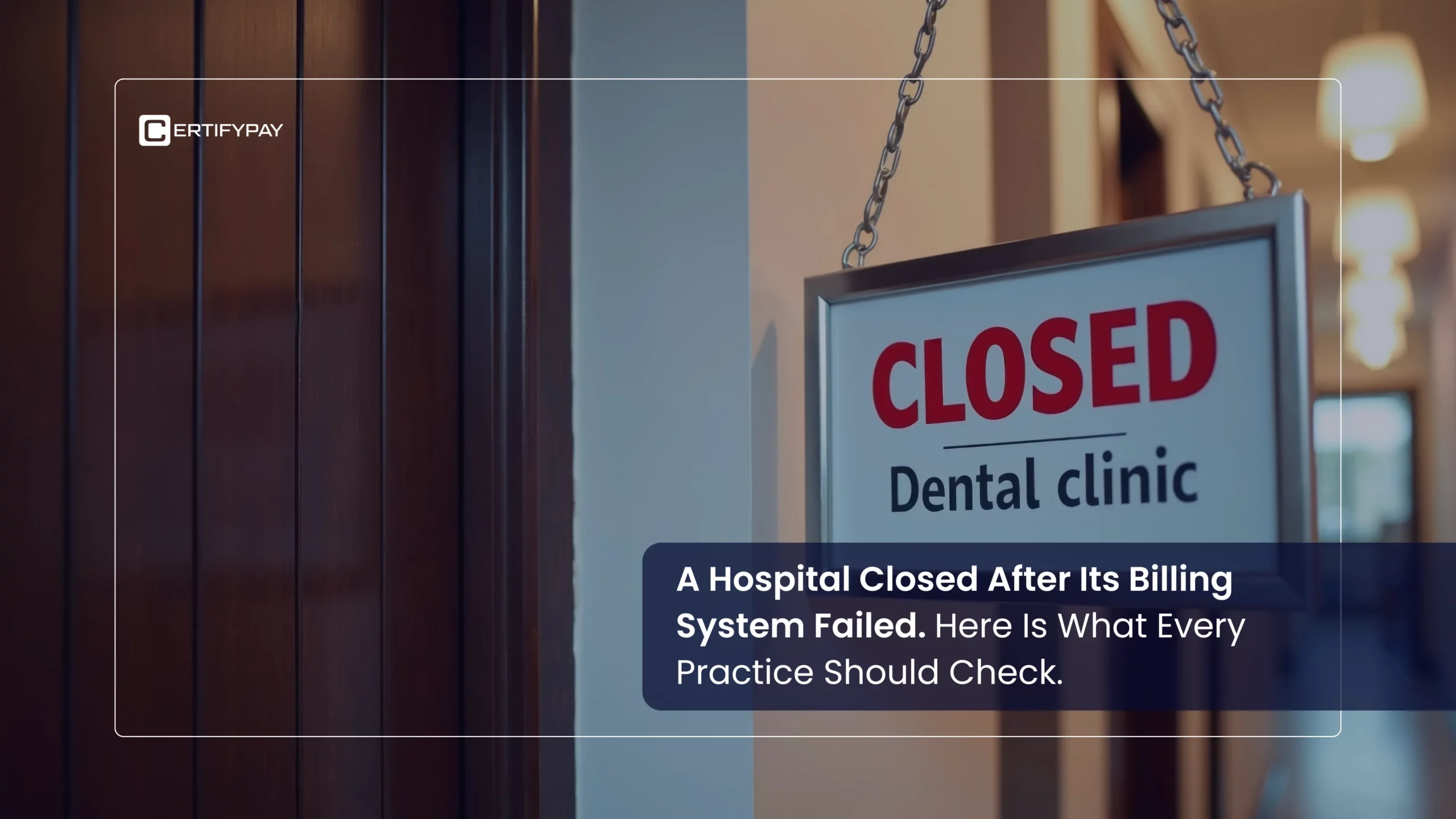
A safety-net hospital in a major metro area closed this year. It served around 100,000 patients. Many of them had no other nearby option. The operator blamed a billing system failure for a year of lost revenue. A state regulatory audit found more problems on top of that. The hospital is now shut. The patients are displaced.
This is about what happens when billing breaks down slowly – and nobody catches it in time. Every practice administrator should read this as a checklist for their own operation.
What the Operator Said Went Wrong
The operator did not point to a sudden drop in patients. They did not cite a single crisis. They pointed to a billing system that stopped working – and kept failing long enough to wipe out their financial reserves.
A state regulatory audit found more operational failures. The details are part of an active legal dispute. But the pattern is clear. Billing broke down. Revenue stopped. The practice could not recover.
That sequence is not unique to large hospitals. It can happen in any practice that runs billing on old tools, disconnected systems, or manual processes nobody has reviewed in years.
Why Billing Failures Stay Hidden
Billing does not collapse overnight. It erodes. A claim gets rejected and nobody follows up. A resubmission sits in a queue nobody checks. A payer rule changes and the system misses it. Each failure looks small on its own. Across hundreds of claims a month, it becomes a revenue gap that grows fast.
The real problem is visibility. Most practices know how many patients they see. Far fewer know their clean claim rate. Or their average days in accounts receivable. Or how much money is sitting in denied claims right now. Revenue cycle management software surfaces that data every day. Without it, billing problems stay hidden until they show up as a cash shortfall.
By then, the damage is already months old.
Three Things to Audit in Your Own Practice
Claim submission and follow-up. How many of your claims go out clean the first time? How many come back denied? Who owns the follow-up – and how fast does it happen? If the answer to any of these is “we are not sure,” that is your first gap. Revenue cycle management software should show you this in real time. Not at the end of the month.
Payer rule compliance. Payer rules change all the time. Coding updates. Prior auth requirements expand. A billing system that does not keep up will produce more denials over time – quietly, consistently, and at scale. This is where outdated or fragmented billing tools cause the most damage.
Point-of-service payment collection. More practice revenue now comes from patients directly – not just insurers. Copays, deductibles, and balance bills that are not collected at the visit turn into receivables. Those are hard to chase and often never collected. Healthcare payment solutions that collect at check-in stop this gap from opening. That pattern compounds quietly. Practices still sending paper statements are losing a real percentage of revenue every single month.
What Nearby Practices Should Do Now
When a hospital closes, its patients do not stop needing care. They move to whoever is closest and easiest to access. In this case, 100,000 patients are looking for new providers right now.
That is an operational pressure point, not just an opportunity. A practice that cannot onboard new patients quickly will lose them to whoever can. Can patients book without calling your front desk? Can they complete intake before they arrive? If the answer is no, your staff will absorb the volume manually and the bottleneck shows up in wait times, missed appointments, and incomplete intake records.
Practices that gain from a nearby closure are the ones whose intake workflow can handle a sudden increase in new patients without adding headcount. The ones that cannot will feel it within weeks.
The Question to Ask This Week
The hospital that closed did not fail in one quarter. The billing system eroded over months. The revenue gap grew slowly. By the time anyone saw the cash problem, it was too late to fix it.
The question is not whether your billing is perfect. The question is whether you would know if it was failing. Revenue cycle management software tells you. A manual process or a fragmented billing tool does not.
Practices that treat billing as an admin task will not see the revenue gap until it is large enough to threaten operations.
How CERTIFYPAY Closes These Gaps
CERTIFY Pay gives practices real-time visibility into their revenue cycle. Claim status. Denial rates. Outstanding patient balances. All in one place through the revenue cycle management dashboard. Denials trigger follow-up automatically. Patient payments are collected at the visit – not weeks later.
The billing and RCM operations module connects payment collection to the patient visit workflow. By checkout, the patient’s financial responsibility is confirmed and collected. The receivables gap that quietly compounds over months does not get a chance to grow.
CERTIFY Health’s practice management system handles the scheduling and intake side. New patients can book online and complete forms before they arrive. No added administrative load on your staff.
Schedule a billing infrastructure assessment to find the gaps in your revenue cycle before they find you.