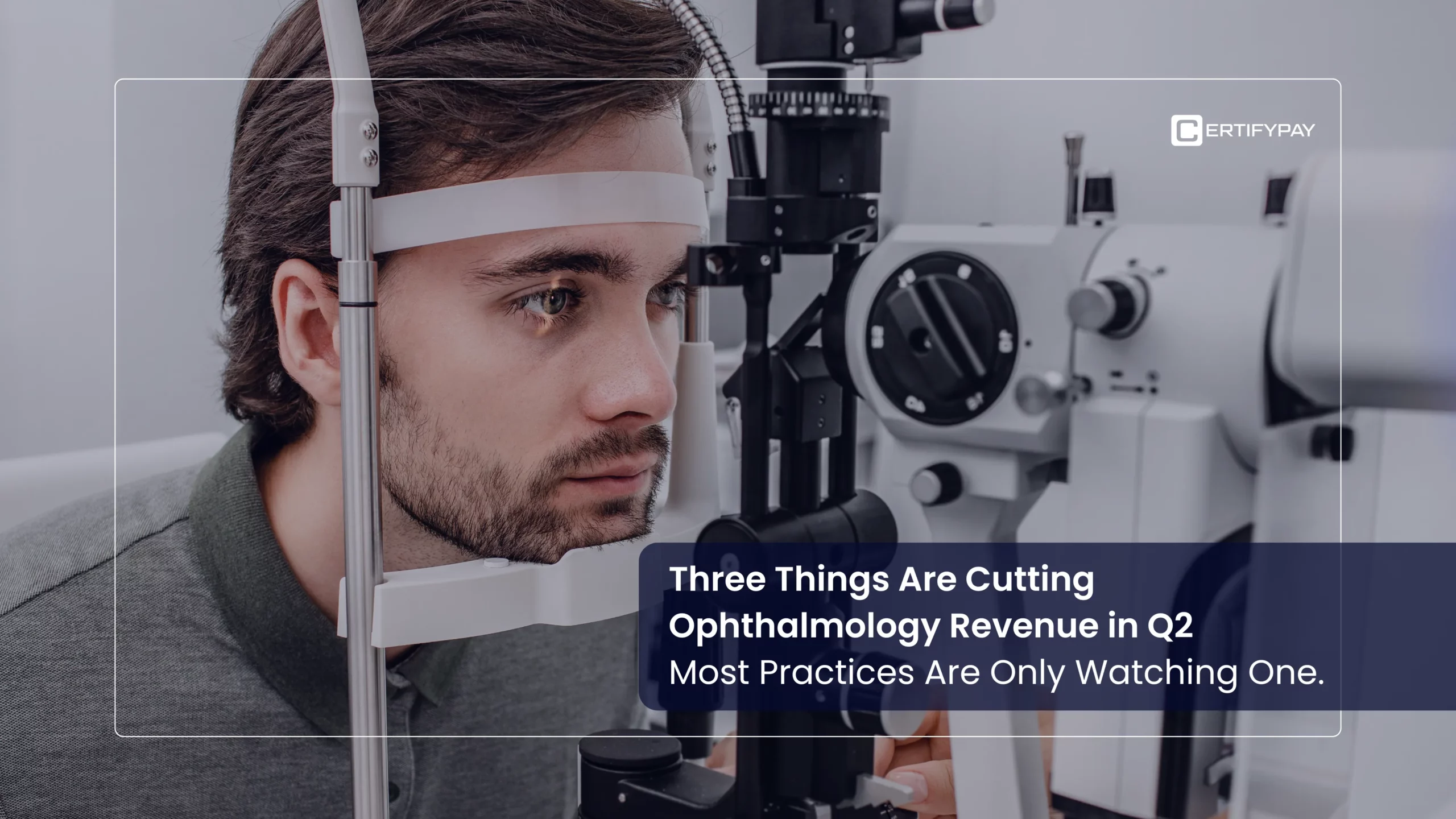
If your Q2 collections are down, you may be looking for one cause. But there are three. They run at the same time, hit different payers, and each needs a different fix. Practices without the right healthcare payment solutions in place are often the last to see the full picture.
Ophthalmology ASCs and practices in 2026 face a tough combination. There is a Medicare reimbursement cut, a commercial payer authorization expansion, and a billing error pattern most teams miss until the quarter is already closed. If your reporting does not separate these three issues, you are managing revenue blind.
The 11% Cataract Cut Is Already in Effect
CMS finalized an 11% cut to cataract surgery reimbursement in the 2026 OPPS update. For any ASC billing CPT 66984 or 66982, this is live right now. It is not a forecast. It is already showing up in your posted payments.
The exposure grows with volume. A practice running 30 cataract cases per week will build a real shortfall before Q2 ends. This happens even if your denial rate stays the same. Practices that leaned on high-volume standard phaco to anchor ASC revenue carry the most risk.
Here is where the operation breaks down. If your team keeps scheduling at the same pace, the cut does not show up as a denial. It shows up as an unexplained gap in reconciliation. Billing teams rarely flag it until most of the quarter is gone. By then, there is nothing left to recover.
Audit your 66982 versus 66984 coding accuracy now. The pay difference between standard and complex phaco is significant. Miscoding in either direction creates underpayment exposure. It can also trigger payer review on your claims.
PA Demo Is Active in 10 States and Covers Procedures Your Staff May Not Expect
CMS’s Prior Authorization Model Demo is now active in ten states. These include California, Florida, Tennessee, Pennsylvania, Maryland, Georgia, New York, Texas, Arizona, and Ohio. It covers outpatient procedures billed by ASCs to Medicare. This includes blepharoplasty (CPT 15822, 15823) and lid procedures that need functional documentation.
The problem is not that prior auth exists. The problem is how most practices handle it. Many run mixed workflows where some procedures need prior auth and some do not. Staff make that call manually at scheduling. That is exactly where errors happen. A scheduler who does not know that 15823 requires PA in Georgia will book a case the payer will not cover.
The denial comes after the service is done. Block time is used. The case is complete. Then the claim sits in a 30- to 45-day appeal cycle it should never have entered. At a multi-surgeon ASC running 15 to 20 lid cases per week, one broken PA workflow is not a single mistake. It becomes a recurring AR problem that grows with every scheduling cycle.
The fix must be both procedural and systemic. Your prior-auth workflow needs to flag PA requirements by CPT code and state before the case is confirmed. Not after the claim is submitted.
Laterality and Modifier Errors Are Generating Silent Underpayments
This is the pressure most practices are not tracking – and the most likely source of consistent, quiet revenue loss across both Medicare and commercial payers.
Here is the key problem. When claims are reduced rather than denied, they do not create a worklist item. They simply post. Nothing triggers a review. The revenue leaves without any flag. It only shows up if someone runs payment variance reports by CPT code and payer. Most ophthalmology billing teams are not doing that every week. That is the gap.
Laterality modifiers RT, LT, and 50 directly affect payment on cataract and retinal procedures. Payers apply different rules based on two things: whether the procedure is unilateral or bilateral, and whether it is the first or second eye in a series. A CPT 66984 claim submitted without the correct laterality modifier gets reduced or cross-applied against a prior claim. No notice is issued.
Modifier 25 carries the same risk. If you bill an E/M on the same day as a minor procedure – such as 92012 alongside an injection -you need documentation showing the evaluation was separate. Payers now use automated review to reduce those claims. They do not deny them.
A pattern of 8 to 15% reductions on laterality-affected claims adds up fast. Across 40 to 60 weekly surgical cases, this becomes a real Q2 shortfall. Running automated payment variance tracking through your revenue cycle management software catches the problem early. You close the gap before it accumulates – not after reconciliation is already done.
Why All Three Hit Harder in the Same Quarter
The 11% cataract cut lowers revenue on every case. The PA demo creates failure risk before lid procedures start. Laterality and modifier errors shrink payments on your busiest codes. Without the healthcare payment solutions in place, month-end reports miss all three. They just show a drop with no clear cause.
What to Do Before Q2 Closes
Start with your cataract coding. Run a CPT 66984 and 66982 reimbursement variance report against 2025 actuals to separate rate-driven loss from coding errors. If 66982 complexity claims are sliding into the lower 66984 rate, that is a recoverable gap hiding inside your posted payments.
Then move to your PA workflow. Confirm that CPT 15822 and 15823 are triggering a prior auth check by state at the scheduling stage – not at claim submission. If the flag is firing after the case is booked, the denial is already in motion.
Finally, pull April and May claims and filter for payment reductions on modifier 25 and laterality-affected codes. These will not appear on a denial worklist. Cross-reference expected versus actual payment by CPT across your top 10 surgical codes and map where the reduction patterns sit. That tells you whether the Q2 shortfall is rate-driven, auth-driven, or modifier-driven – and where to act first.
If those three audits are running across separate systems or manual processes, the checks will not connect and the gaps will stay invisible. CERTIFYPAY processes ophthalmology claims in a single billing workflow. It keeps full audit trails at the claim level. Your team can check laterality modifiers, PA on lid cases, and modifier 25 documentation in one place. They are not hunting across three systems.
The value is not that CERTIFYPAY makes billing decisions. The value is that your team makes those decisions with complete, connected data. They see what they need without chasing answers across disconnected tools.
If your team is managing these checks across separate systems or manual processes, the Q2 revenue impact is already running. The audit will show you exactly where.